by Rae Cine
Trigger warnings. Spoilers.
It was in a fiction workshop at Sewanee Writers’ Conference when one of the workshop leaders said to the attendees, “Cormac McCarthy is Irish for don’t try this at home.” It was a response to my comment about McCarthy’s aesthetic—the limited punctuation, lyrical prose, unflinching detail to human vulnerabilities and violences. I was a fan. The leader’s comment was supposed to be funny. And it was funny in the delivery. Well-timed. The workshop attendees laughed. Who wouldn’t laugh at a famous author’s joke? I did not laugh. I was embarrassed and distracted from the conversation I was trying to have about style and prose mastery, a conversation I wanted desperately to have at Sewanee and one that I would later have with my advisor, Alice McDermott, who also did not laugh at her fellow workshop leader’s joke. She was my first workshop advisor at Johns Hopkins and she knew me a little and I think she saw I was trying to encourage a conversation, not a joke. It isn’t always easy for female, emerging writers to be taken seriously by male authors or academia or anyone, if we are to be honest. Or perhaps McDermott felt an obligation to simply take an emerging writer’s comments seriously. Either way, for me, she gained moral authority in the workshop from that moment forward, which coupled with her craft authority, made it easy to understand how she is so regarded in literary circles and academia.
This experience taught me an incredible lesson, not so much how to navigate the demeaning comments of male authors making jokes at the expense of younger, female writers, which happens quite a bit. I knew how to navigate that already, but rather, how to lead a conference workshop and how not to lead a conference workshop. I had two amazing examples right in front of me that day. Alice McDermott, arguably the prosaist of our time and incredibly generous with her care and craft. And the Jokester shutting down conversation, embarrassing a young female writer in front of a room full of writers. This was important to me. I had already been teaching literature and creative writing a few years and so I knew that teaching, like writing, was a craft to be learned and nurtured. Needless to say, I am not a fan of the Jokester.
“A child of God much like yourself perhaps.”
It is rare to find prosaists such as McCarthy, authentically from Appalachia and writing about Appalachia in a way that is so very lyrical and organic to the cadence of the land and the people. Child of God is arguably Cormac McCarthy’s most violent novel, if you don’t count Blood Meridian, which every writer should read, in my opinion. Child of God is set wholly in Appalachia as opposed to the trilogy and The Road, also must reads. But more than this, Child of God gives us a glimpse into the moral positionalities and gender politics of McCarthy’s storytelling that is authentically Appalachian, an important focus for me being a daughter of “God” and Appalachia, myself. And so I have found myself returning to the work often as a master study. As repugnant as the gender positionalities are within McCarthy’s novels, I find authenticity in these positionalities. They are in many ways similar to how I grew up. And no other McCarthy character represents more combined misogyny and moral depravity than Lester Ballard.
In the opening of Child of God, we meet Ballard, a man as devoid of moral authority as any character before him or after. And we meet him at his most vulnerable as he loses his home:
They came like a caravan of carnival folk up through the swales of broomstraw and across the hill in the morning sun, the truck rocking and pitching in the ruts and the musicians on chairs in the truckbed teetering and tuning their instruments, the fat man with guitar grinning and gesturing to others in a car behind and bending to give a note to the fiddler who turned a fiddlepeg and listened with a wrinkled face. They passed under flowering appletrees and passed a log crib chinked with orange mud and forded a branch and came in sight of an aged clapboard house that stood in blue shade under the wall of the mountain. Beyond it stood a barn. One of the men in the truck bonged on the cab roof with his fist and the truck came to a halt. Cars and trucks came on through the weeds in the yard, people afoot.
Read the full essay at Eckleburg.
Where Moral Authority Begins
Part I: Toni Morrison’s Beloved
Part II: Dorothy Allison’s Bastard Out of Carolina
Part III: Cormac McCarthy’s Child of God
Part IV: Jesmyn Ward’s Sing, Unburied, Sing
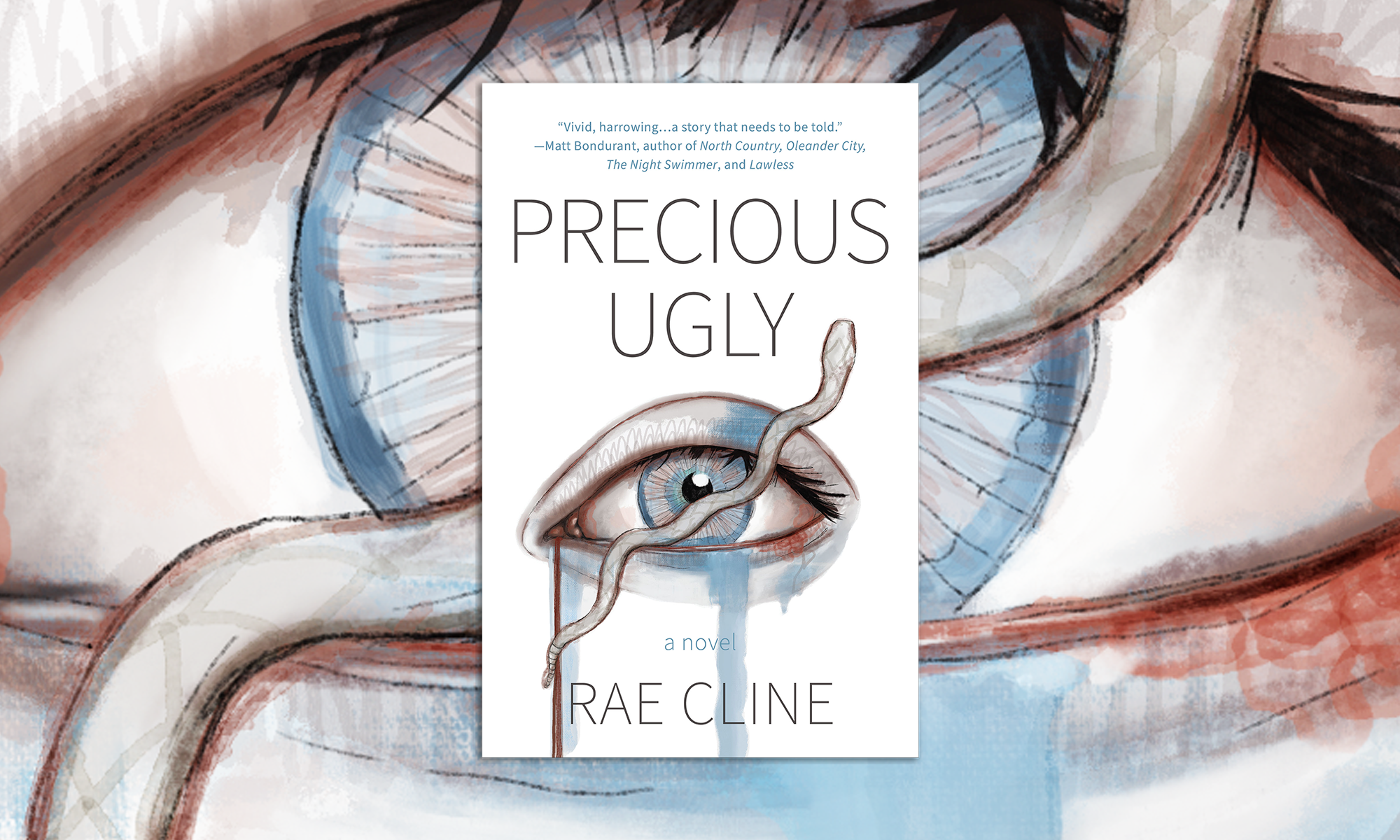
Rae Cline’s debut novel, Precious Ugly (7.13 Books), is a work of Appalachian literary fiction. It was a finalist for the Curt Johnson Prose Award and CRAFT’s First Chapters Contest. Her short fiction and essays have appeared in The Paris Review, McSweeney’s, North American Review, and StoryQuarterly. She is the founding editor of Eckleburg and lives in New York City.