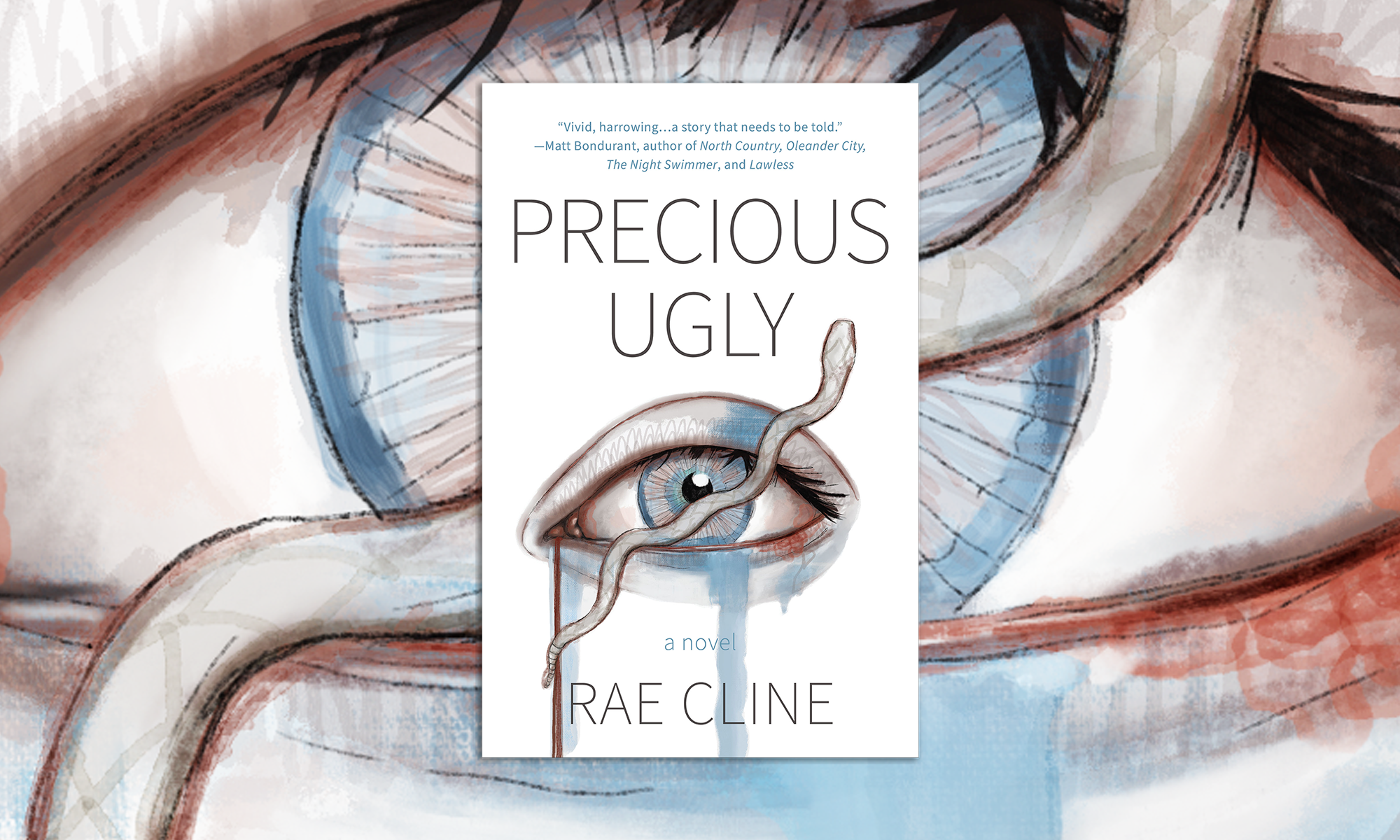

Download the Precious Ugly Book Club Kit
“Precious Ugly may be the year’s most powerful debut.”
—Largehearted Boy, Book Notes
Welcome from Rae Cline
Dear Readers,
Thank you for choosing Precious Ugly and for bringing Clementine into your conversation.
I wrote this novel with questions I didn’t want the book to answer too easily: What does safety mean to a girl who has never been safe? What happens when love, faith, and authority become impossible to separate from fear? Who gets to decide what survival should look like for someone else?
Precious Ugly takes place in 1985, but Clementine’s world is both intimate and national—a conversion van and a campsite, a father and daughter, against an America shaped by religious certainty, economic precarity, nuclear anxiety, and the silences surrounding the AIDS crisis. At its center, though, is a thirteen-year-old girl trying to understand what she has inherited and what, if anything, she can choose for herself.
I hope you disagree with one another as you talk about this book. I hope you find yourselves changing your minds about characters, questioning judgments that initially felt certain, and noticing the moments when Clementine understands something before she has the language to name it.
This kit is meant to extend that conversation. You’ll find questions, historical context, music, recipes, activities, and further reading—but there is no prescribed way to read Clementine’s story. Your experience of it belongs to you.
Most of all, thank you for reading Precious Ugly closely enough to talk about it with one another.
Rae Cline

A Note Before You Begin
Spoiler Notice: This book club kit discusses Precious Ugly in its entirety, including major events and the ending. I recommend finishing the novel before reading further.
Discussion Questions
Clementine & Survival
-
- In the first chapter, Clementine strategizes her escape but ultimately decides to wait. What are the major complications to her leaving the campsite?
- After the snake fry, Daddy appears to walk on water. How do each of the characters interpret this event? And how do these interpretations reflect on them?
- When Daddy appears at the Hilltop House Hotel, Mama is angry but accepts him back into their lives. What are Mama’s motivations?
- Why does Clementine participate in the Signs Following ritual?
- What do you think happens to Clementine when she sends Daddy away from the hospital?
Faith, Authority & Violence
-
- Daddy’s followers experience him differently than Mama and Clementine. What would happen if Daddy’s followers were to know the true Daddy?
- Beater supports Daddy’s religious endeavors even though he sees Daddy’s abuses. What motivates Beater’s decisions?
- Mama speaks to Clementine often about what a man is and wants. Why does Mama stay? Why does she work so hard to explain Daddy’s behaviors?
- Daddy chooses an abandoned McDonald’s for his McChapel. Why McDonald’s?
- Why does Clementine choose the Signs Following service to take agency over her body?
America, 1985
-
- How did Reagan policies impact Daddy’s sense of self and his position within his family? How does this compare to Beater’s experience in the Reagan era?
- What are Clementine’s anxieties and fears about nuclear war and how does this inform her anxieties and fears about Daddy?
- Nurse Rosemary Hooks cares for AIDS patients in the hospital basement. How does this scene impact Clementine’s view of the world and Harpers Ferry?
- How does Daddy’s faith in Reagan policies and leadership reconcile with the economic realities of his family? How is Clementine’s experience with faith reflective of 1985 Reagan era America?
- Nurse Rosemary and Beater experience Harpers Ferry communities and Reagan era policies differently than Clementine and her family. How do the three characters navigate their individual challenges? Are their similarities? What are the greatest distinctions between their challenges in this era?
1985: The World of Precious Ugly
Reagan Presidency
Ronald Reagan served as the 40th president of the United States from 1981 to 1989. His presidency championed conservative politics, tax cuts, deregulation, increased military spending, and a renewed emphasis on traditional American and Christian values. His administration governed during the final decade of the Cold War, when nuclear anxiety remained part of everyday American life, while cuts to social programs accompanied growing economic inequality and homelessness. The Reagan administration was also widely criticized for its delayed public response to the emerging AIDS epidemic.
Cold War & Nuclear Anxiety
For a thirteen-year-old in 1985, nuclear war was not an abstract piece of history—it was something that could seem capable of happening at any moment. The United States and Soviet Union possessed enormous nuclear arsenals, and children grew up with news of the arms race, political conflict between the superpowers, and the possibility that a nuclear attack could destroy entire cities. Movies, television, music, and school conversations brought that fear into everyday life. The world could end, and the adults in charge might be unable to stop it.
AIDS Crisis
By 1985, AIDS had become a devastating public-health crisis in the United States, yet fear, stigma, and misinformation surrounded the disease. Gay men were disproportionately affected and frequently subjected to discrimination, while many Americans treated AIDS as something shameful or unspeakable. Thousands had already died, but President Reagan had not yet publicly addressed the epidemic. For a thirteen-year-old, AIDS might have been frightening precisely because adults, schools, families, and the government often struggled—or refused—to speak openly about what was happening.
Economic Policy & Poverty
By 1985, the United States was recovering from a severe recession, but the recovery was uneven. President Reagan’s economic policies emphasized tax cuts, deregulation, reduced spending on some social programs, and the belief that economic growth would benefit Americans broadly. While unemployment had fallen from its recession-era peak, poverty remained high, and homelessness had become increasingly visible in American cities. For families already living at the margins, the era’s language of prosperity could feel very different from the reality of hunger, insecure housing, and limited public assistance.
Religious Conservatism & Televangelism
In the 1980s, conservative Christianity became an increasingly powerful force in American politics and popular culture. Televangelists reached millions of viewers through television, preaching faith, traditional family values, personal salvation, and often conservative political causes while soliciting donations from their audiences. Religious leaders increasingly aligned themselves with the Republican Party and the Reagan presidency. For a child in 1985, religious authority could arrive not only from church and family, but through the television—where charismatic preachers promised salvation, miracles, and certainty.
Harpers Ferry & Northern Appalachia
In 1985, Harpers Ferry sat at a complicated crossroads of Appalachian geography and American history—a small West Virginia community where the Potomac and Shenandoah rivers meet, shaped by industry, the railroad, John Brown’s raid, and a remarkable Black history that included Storer College and the Niagara Movement. The surrounding Appalachian region was experiencing economic hardship and uneven access to resources, conditions that could fall especially heavily on poor and marginalized people. Harpers Ferry itself had a long-established African American community rooted in generations of struggle for education, property ownership, and civil rights.
For gay and lesbian people in rural Appalachia, the 1980s could bring another kind of marginalization. Conservative social and religious norms, limited visibility, and the absence of openly queer institutions could make community difficult to find—particularly during an AIDS crisis that intensified stigma around homosexuality. Queer Appalachian life nevertheless existed, often beyond the narratives that portrayed rural communities as places where gay people simply were not present. Scholarship on queer rural America has specifically challenged that erasure.
Mama’s Camp Kitchen

Precious Ugly Playlist
“In Precious Ugly I needed to build a music bubble around my character, Clementine—thirteen, pregnant and living in a conversion van on a campsite with her mother and father, an abusive alcoholic who fancies himself a miracle worker, a cult leader.”
Book Club Activity
What five things should Clementine take with her in the canoe? Explain your choices, including how she might acquire them on the campsite.
Further Reading
Continue the conversation with works that explore gender, poverty, violence, race, family, survival, and the stories communities tell about themselves.
Invite Rae to Your Book Club
Reading Precious Ugly with your book club? Invite Rae Cline to join the conversation. Rae is available for select virtual and in-person book club visits to talk about Clementine, the world of Precious Ugly, the novel’s 1985 setting, Appalachian literary fiction, and the questions your group brings to the book.